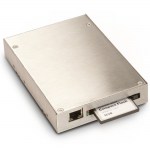
 . Southern Manufacturing & Electronics, Farnborough, United Kingdom – Solid State Disks Ltd. (SSDL), a leading manufacturer of solid-state-drives (SSDs) and a value-added reseller (VAR) of latest-technology Flash and DRAM solutions, has launched SCSIFlash-Fast™, a swap-in upgrade/replacement for electromechanical hard disk drives (HDDs) that use the SCSI interface. Initially available with 68- and 80-pin connectors and write speeds of up to 80MB/s, SCSIFlash-Fast™ uses proven SCSI drive architecture and industrial CFast or M.2 SSD memory (with storage capacities ranging from 2GB to 1TB). The drive features configurable hardware, allowing the OEMs of (or those responsible for maintaining) legacy systems to replace or upgrade obsolete HDDs that were made in the 1980s, 1990s and early 2000s, and improve system reliability and security. James Hilken, SSDL’s Sales & Marketing Director, says: “There are several computer-based systems in use within aerospace, defence, manufacturing, medical, telecommunications and other sectors that were designed decades ago and were fitted with then state-of-the-art SCSI hard disk drives. With their moving parts, these long-obsolete drives are increasingly failing. Our SCSIFlash-Fast drive is a highly reliable swap-in replacement for virtually any SCSI hard disk drive that’s more than 20 years old.” SCSIFlash-Fast™ is configured to order and can replicate the exact behaviour of the SCSI HDD it replaces, meaning no modifications need to be made to the host system; which in many cases must not be modified (i.e. its functionality has been certified) or it is simply not cost-effective to do so. With SSDL’s SCSIFlash-Fast™, the SCSI version is set to that of the host system (SASI, SCSI-1, SCSI-2 or Ultra3) and the disk sector size is set to 256, 512, 768, 1024, 2048 or 4096. Other configurations can also be applied, including the preloading of data. “We have made it possible to remove an old-tech SCSI drive and insert a SCSIFlash-Fast and the host system will not detect the difference,” adds Hilken. “Also, because ours is a solid-state drive it is far more reliable than the drive it replaces, is more secure, draws less power and is quieter. It can also be networked, thanks to an optional Ethernet port, which means it can be accessed remotely for backs ups and system reboots, for example.” Other SCSIFlash-Fast™ features include its ability to automatically detect 16- or 8-bit data operation, as well as single-ended (SE) and low voltage different (LVD) signalling. Also, more than one SCSI address and logical unit number (LUN) can be supported by a single unit, and its microcode is field upgradable via USB. SCSIFlash-Fast™ requires a 5VDC supply and will consume just 0.8W (plus whatever power the storage media draws, which will vary depending on memory type). The form factor is an industry-standard 3.5” disk drive (102 x 147 x 25mm (W x L x H)). SCSIFlash-Fast™ is available immediately and detailed datasheets of the two launch drives can be viewed and downloaded from www.solidstatedisks.com/legacy-tapes-drives.
 |
 |
Available with 68- (left) and 80-pin (right) connectors, Solid State Disks Ltd.’s SCSIFlash-Fast™ drive can replicate the exact behaviour of virtually any SCSI hard disk drive, thus restoring the reliability of (and user confidence in) computer-based systems design decades ago, still relied on today and which must provide several more years of service. Media contacts: James Hilken, Sales Director, Solid State Disks Tel: +44 (0) 1189 323499. Email: This email address is being protected from spambots. You need JavaScript enabled to view it. Amanda Warrilow, Communications Officer Email: This email address is being protected from spambots. You need JavaScript enabled to view it. Tel: +44 (0)1522 789000
 Reading, United Kingdom. Solid State Disks Limited’s (SSDL’s) SCSIFlash technology has been shortlisted for a Manufacturing Supplier Innovation Award US 2025: in the ‘Most Innovative Use of Reverse Engineering’ category. The shortlisting recognises SCSIFlash’s ability to not only extend the life of equipment used in semiconductor fabrication but also allow users to progress their digital transformation journeys. “We’re delighted to have been shortlisted for this prestigious award,” commented James Hilken, Sales Director of SSDL. “It reflects the hard work our engineers put into making SCSIFlash such a clever and versatile technology.” Whilst semiconductor fabs make very high-tech and high-value products, ironically, the computer-based processing tools they use are often decades old: and the data storage devices are often early generation SCSI hard disk drives. With their moving parts, these old drives are increasingly at risk of failure. Understandably, the drives are long obsolete. SSDL’s SCSIFlash technology has made possible the creation of solid-state, form-fit-function replacements for virtually any legacy electromechanical drive that uses a SCSI interface (i.e. SASI, SCSI-1 and SCSI-2), or indeed PATA/IDE or ESDI. “To create our range of SCSIFlash drives, our highly experienced engineers worked from original circuit diagrams, mechanical drawings and other documentation, where available,” added Hilken. “And for the data/signal interface the company interrogated several original drives using oscilloscopes and logic analysers.” SSDL’s SCSIFlash drives have been used to replace legacy drives in manufacturing equipment made by Canon, DEC and Lam Research, for example, and end users (fabs) include Applied Materials, ASM, Seagate, Texas Instruments and Western Digital. Hilken concluded: “Again, we’re delighted to have been shortlisted for this Manufacturing Supplier Innovation Award, as SCSIFlash really does reflect our reverse engineering capabilities.” You can vote for us here https://form.fillout.com/t/6qCZLF1wNgus For further information on our Reverse Engineering capability can be found here

.
Reading, United Kingdom – Solid State Disks Limited (SSDL) has been awarded a contract to supply the NATO Airborne Early Warning & Control Force (NAEW&CF), based in Geilenkirchen, Germany, with 40 solid-state data storage drives for use in Airborne Warning and Control Systems (AWACS) aircraft.
The contract was awarded by the NATO Support and Procurement Agency (NSPA) and the drives are based on SSDL’s popular SCSIFlash™ technology; modified to use CFast cards, as opposed to standard Compact Flash cards.
The drives are to be used to replace AWACS removable media assemblies (RMAs) that currently use Seagate hard disk drives (HDDs) that are more than 20 years old. SSDL’s drives will replace the original RMAs and replicate the exact behaviour of their HDDs – so no modifications need to be made to any of the aircraft when upgrading to the new drives.
In addition, the SCSIFlash-based RMAs provide functionality the original units never had. For example, at the request of NAEW&CF, the replacements include the ability to eject the CFast cards, whereas before the original HDD-based units had to be removed in their entirety, risking damage to the connectors on the rear. The replacement drives also have an Emergency Erase button on the front panel; this to destroy all data on the CFast card if the crew feel there is a risk of the aircraft falling into enemy hands.
Also, whereas the original RMAs have heaters for use in extremely low temperatures, SSDL’s solid-state-based solution requires no heating. Indeed, the replacement RMAs meet the environmental test requirements for equipment used on the AWACS, requirements that draw from parts of MIL-STD-810G.
The intended service life of the replacement RMAs is 13 years, during which time SSDL will provide technical support to ensure the units continue to function correctly. Support will include obsolescence management of the new RMA’s components.
“This is an important contract for us,” comments James Hilken, Sales Director of SSDL, “and is a prime example of our reverse engineering capabilities in the aerospace and defence sector. In switching to our SCSIFlash-based solution, the reliability of the RMAs has been greatly improved and NAEW&CF has capabilities they did not have before.”
The replacement units will be supplied with two USB cables, one for unit configuration and one for applying firmware updates.
NAEW&CF is also considering the purchase of SSDL’s CFast health monitoring software. It is a customised version of the industry-standard self-monitoring, analysis and reporting technology (SMART) that is included within most HDDs and SSDs. The PC-based software can be used to show the life remaining in the CFast cards.
SSDL also developed test frames, into which the new RMAs can be inserted. Developed for SSDL’s manufacturing and QA procedures, the test frames provide easy access to all signals on the RMA’s two rear connectors and will significantly simplify maintenance operations. Another use is to provide an easy method of connection to host systems at ground stations. NAEW&CF has an option to buy test frames.

SSDL has been awarded a contract to supply NATO with solid-state-based removeable media assembles (RMAs). Employing the company’s SCSIFlash™ technology, the RMAs use CFast cards as the storage media and have emergency erase buttons.

SSDL has been awarded contract to supply NATO with solid-state-based removeable media assembles (RMAs). Employing the company’s SCSIFlash™ technology, the RMAs use CFast cards as the storage media and have emergency erase buttons.
Media contacts:
James Hilken, Sales Director, Solid State Disks
Tel: +44 (0) 1189 323499. Email: This email address is being protected from spambots. You need JavaScript enabled to view it.
Amanda Warrilow, Communications Officer
Email: This email address is being protected from spambots. You need JavaScript enabled to view it.
Tel: +44 (0)1522 789000

Reproduced here with the kind permission of the Editor of DENA (Design Electronics North America).
Article in June 2024 issue of DENA. View pdf of the article here
Solid-state replacements for old tech’ drives can give decades-old systems a new lease of life, but what’s involved in making one?
Within many industry sectors, computers and computer-based systems that were designed and built decades ago are in regular use, are heavily relied upon and must provide several more years of service.
For instance, in the telecoms sector, operators are legally obliged to continue providing certain services; ones that run through old base stations and exchange system hardware. And in the aerospace and defense sectors there are, for example, radar systems, training simulators and automatic test equipment (ATE) systems in use that were designed in the 1980s.
These systems were designed to use then state-of-the-art data storage devices such as early generation SCSI, IDE (PATA) hard disk and tape drives, and even ESDI, Shugart, and IDC floppy disk drives. With their moving parts, these drives are becoming increasingly unreliable. Understandably, the drives became obsolete years ago.
Moreover, it is the physical interface that is obsolete, so even finding a similar drive is challenging. And if one can be found, there are still likely to be problems. For example, SCSI was an extremely popular way of connecting computer peripherals in the 1980s (and through to the early 2000s). It was standardized in 1986 as the SCSI parallel interface (SPI), 8-bit wide, single-ended bus.
The standard evolved through a number of iterations, doubling the number of data lines to 16 and incorporating differential signaling before finally being superseded by the serial attached SCSI (SAS) interface. However, the word ‘standardized’ should be taken with a pinch of salt because OEMs did not always implement the full standard. They often retained just the SCSI command protocol or the SCSI architectural model. Also, many SCSI drives were designed with a specific host in mind, and the latter would only physically interface with an exact make and model (number) of drive. See Figure 1.

Figure 1 – The position of the 50-pin data and control connector and the 4-pin Molex connector (for power) on this Fujitsu SCSI HDD are positioned such that they only align with a specific IBM host computer.
Also, there are instances where a host system and drive were designed to behave in a mutually exclusive manner, under particular circumstances – i.e., the OEM of the host and the OEM of the drive collaborated to agree things like mode page setting or a vendor unique mode page in the memory map. Or the OEMs may have agreed certain handshaking protocols when messages between host and drive take place.
Such pairing between host and drive was a common practice, meaning a secondhand drive needed to keep a host computer operational might need to come from an identical host. An extremely unlikely find. And even if one can be found, what will its life expectancy be? Also, the host might be able to ‘recognize’ that a new drive has been inserted and might look for certain data to be present (i.e., not just lots of zeros); again, something that might have been agreed between the OEMs.
It is also worth noting that many systems engineers (particularly in aerospace and defense) recognized that the drive was potentially a weakness in the reliability of the host system and had the foresight to buy spares and place them in storage. To their dismay, users are now finding these spares are crashing when powered up. Again, the use of moving parts is the problem. In the case of HDDs, many models had heads that rested on the surface when not spinning. Over time the heads may have stuck to the surface. This could result in preventing the disks from spinning or ripping the heads from their suspension mechanisms.
In essence, the failure of a drive is a serious issue. Finding an exact-match secondhand drive is challenging and an unused, out-of-the-box spare that has been in stores for years is likely to crash.
Importantly, modifying the host is impractical in most cases; it would need to spend too much time offline. Moreover, modification might not be permitted. In the defense sector, for example, the host system’s functional behavior will most likely have been certified. A replacement drive that can be quickly swapped in is the only logical solution.
Emulation
In recent years a few companies have set up specializing in the design and manufacture of solid-state-based storage devices that can replicate the behavior of these yesteryear data storage drives, even if they were paired to a specific host.
One such company is UK-based Solid State Disks Limited (SSDL). It has produced hundreds of solid-state drives over the years, so the good news – for anyone in need of replacing an electromechanical drive – is that the company has probably replicated it before, in which case the designs (including software drivers) will already exist, and a drive can be manufactured.
But what if a design does not already exist? And how were these existing replacements made in the first place, particularly if the OEMs had tweaked the SCSI standard or done other things to lock in their drive? SSDL Chief Technology Officer, Brian McSloy, explains: “Some details of the original drive and its interface might be available online. If not, we use techniques we’ve developed to interrogate a working drive, either one of the many we have in our engineering department, or a sample supplied by a customer.”
McSloy goes on to say that analysis equipment can always be taken to the host and placed between it and the drive so that signal timings and protocol can be captured (see Figure 2).

Figure 2 – Above, communications between a drive and host are captured.
“This is not an ideal situation though,” adds McSloy, “as we clearly need access to a working drive. Ideally, we need to be brought in before the original drive fails. And even then, we need to take extreme care when handling the original drive, as it will have become very fragile over the years.”
Preparation
Most legacy drives are based on logical blocks, where the exact encoding of the data onto the disk is handled internally by the storage device. For some classes of device, such as ESDI or floppy, the encoding has to be implemented within the new storage device’s firmware. McSloy says this is a complex operation that can only be achieved by reverse engineering the particular implementation, including a detailed low-level examination of the format written to the media, which sometimes varies across the surface.
Also, the solid-state drive needs to be formatted and as mentioned above, if the host is expecting to see certain data present to indicate it is a new drive, it will need to be present too. “However,” adds McSloy, “some hosts will require the old data to be present on the new drive, in which case it needs to be copied. Again, that means having access to a working drive and taking great care when handling it to copy the data.”
In essence, a solid-state replacement (like the one shown in Figure 3) can be created for virtually any SCSI-based drive that was in use in the 1980s to early 2000s, irrespective of how the OEMs of the host and drive (companies that may no longer exist) might have collaborated to uniquely pair their products.

Figure 3 – Above, a solid-state-based SCSI drive with dual CF cards.
As mentioned, modifying the host is impractical, or even permitted in some cases. But as a solid-state drive can be given the same physical connector, interface protocols, memory maps, formatting (including pre-loaded data, if applicable) as the original drive, the host does not need to be modified. “The host will not be aware that a solid-state drive has been fitted,” adds McSloy. “And in many cases, we need to slow down the speed of our drive. For instance, to retrieve data, a tape drive might need to rewind the tape. That takes time. We can provide the data almost instantly, but the host might not be ready for it so soon and flag it is as unusual behavior.”
Solid-State Benefits
With solid-state, reliability is greatly improved (as there are no moving parts) and the drive draws a lot less power than the original electromechanical drive. It is quieter too. As for the storage media used, SSDL has historically used industrial grade Compact Flash (CF) cards, which can be removed and treated like floppy disks, for example. And if the solid-state drive is replacing an HDD, a CF card is still the storage media, but hidden behind a plate so that it cannot be removed.
However, for its latest product, SSDL has switched to M.2 SSD for drives without removable media and CFast for removable media (though as before, it can be made inaccessible). “Where removable media is concerned,” adds McSloy, “CF is starting to fall out of favor and tops out at 64G capacity for the highest endurance class. CFast goes up to 1TB.”
McSloy concludes by saying that obsolescence is a moving target, which means SSDL must move with the times. “For instance, many drives of the 1980s and 1990s were 8-bit and had read-write speeds of no more than 10MB/s. Now, drives from the 2000s are showing signs of wear and we are receiving more and more requests for 16-bit wide SCSI with read-write speeds of up to 80MB/s.”
In summary, the behavior of virtually any drive can be replicated in a solution that is more reliable, draws less power and is more secure, and no modifications need to be made to the host. Also, the solid-state drive can be given features, such as networking, that the original drive never had, and that opens up a whole new world of opportunities.

.
Reading, United Kingdom – Solid State Disks Limited (SSDL) is to supply the NATO Airborne Early Warning & Control Force (NAEW&CF) with health monitoring software for use with its new solid-state-based removable media assemblies (RMAs) that are being used on its Airborne Warning and Control Systems (AWACS) aircraft.
Whereas the original AWACS RMAs used electromechanical hard disk drives (HDDs), that were more than 20 years old and no longer produced, the new RMAs (supplied by SSDL) use removable NAND-based CFast cards for data storage.
“Although solid-state memory is inherently more reliable than rotating disk technology it will eventually fail, largely as a result of memory wear,” comments Brian McSloy, SSDL’s Chief Technology Officer. “Specifically, NAND memory will only support a finite number of Program-Erase, or PE, cycles.”
The software to be supplied to NAEW&CF is Windows-based and will monitor the number of PE cycles executed as well as the number of remaining spare blocks. These contribute to an overall percentage, with 100% denoting healthiest.
Card health is also denoted through a colour scheme the software’s GUI uses, with green indicating healthiest. As the card’s remaining life shortens the GUI’s colour changes, with amber reflecting wear but that no immediate action is required. Red indicates that the monitoring frequency should be increased and that a replacement card procured. Black warns the user that the card has either failed or is about to.
“Helping prolong the life of the CFast cards is the fact that they employ single-level cell NAND Flash technology,” adds McSloy. “This means up to 100,000 Program-Erase cycles should be possible. The cards we supply err on the side of caution though and we state up to 60,000 PE cycles. However, for important applications it is wise not to be overly reliant on theoretical or even advised PE cycle limits, and our software enables users to retire wearing cards in plenty of time.”
The CFast health monitoring software developed by SSDL builds on self-monitoring, analysis and reporting technology (SMART) that was developed for computer HDDs in the 1980s, and which was subsequently expanded to cater for solid-state disks (SSDs) and their failure modes.
“The monitoring software we developed for NATO provides a view into the health of the solid-state memory that the operator never had with their old HDD-based RMAs,” concludes McSloy, “Also, our software can be repurposed and made user-bespoke for many other high security applications in which solid-state memory is relied upon.”

SSDL is to supply the NATO Airborne Early Warning & Control Force with CFast memory card health monitoring software for use with its new removable media assemblies, as used on its AWACS aircraft.
SSDL is to supply the NATO Airborne Early Warning & Control Force with CFast memory card health monitoring software for use with its new removable media assemblies (RMAs), as used on its AWACS aircraft. The card will be ejected from an RMA (above) and placed in a card reader connected to a laptop running SSDL’s health monitoring software. Health will then be indicated as a percentage of remaining life and a colour coding scheme.